
I read 30 books in 2025. It’s less than last year – however I read Stephen King’s 11/23/63 which I think should count as at least three books. Coming in at 849 pages, it’s probably the longest book I’ve ever read!
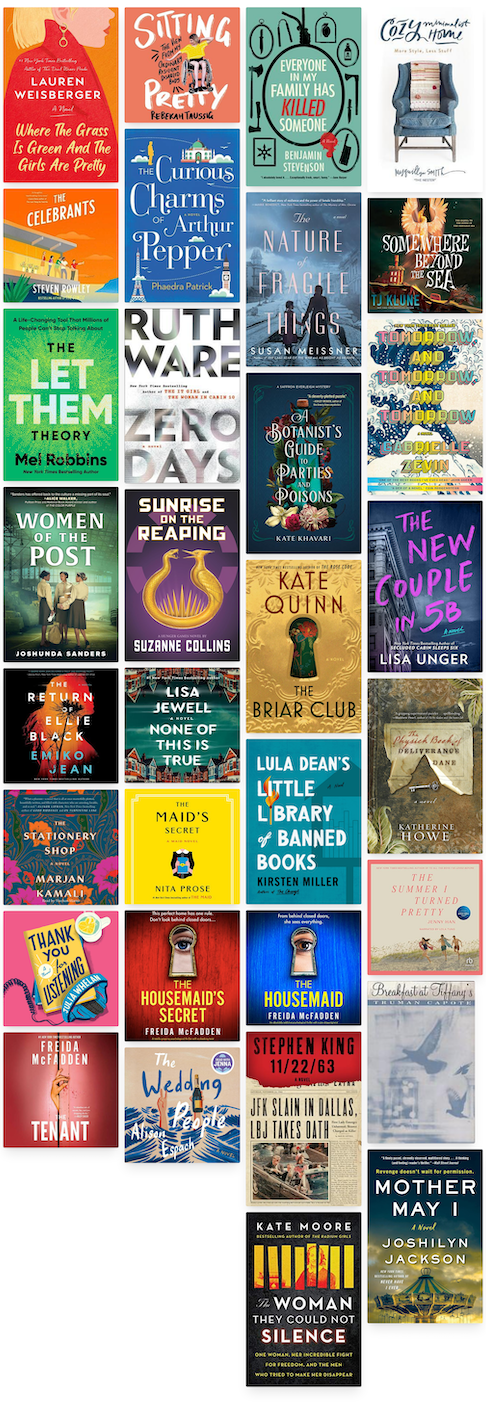
As for the ReadICT challenge, I was one book away from completing the challenge.
- A book with a flower or plant on the cover: The Botanist Guide to Passion and Poisons
- A popular book you have never read: Breakfast at Tiffany’s
- A book by or about a person with a disability: Sitting Pretty
- A graphic novel book adaptation or memoir: I tried to read Maus, but couldn’t get through it.
- A book set on a different continent: The Curious Charms of Arthur Pepper
- Cozy mystery, romantasy, or true crime: The Briar Club
- A book featuring a strong woman: The Nature of Fragile Things
- A book with two or more points of view: Where the Grass is Green and the Girls are Pretty
- A book featuring group dynamics: The Celebrants
- A book that scares you: 11/23/63
- A book with a month in the title: Mother May I
- A book recommended by KMUW or your local library: Everyone in my Family has Killed Someone
My favorite was The Nature of Fragile Things. Set in 1900s around the time of the San Francisco earthquake and resulting fire, it follows a woman who marries a widowed father to escape her poverty-stricken New York like. She soon discovers he has been living a double life. The story follows this woman and two others this man has deceived as they navigate the earthquake disaster in 1906.
I also loved Sunrise on the Reaping, another prequel to the Hunger Game’s trilogy (the fifth book in the series). It follows Haymich Abernathy’s story (who is Katniss’ and Peeta’s mentor in the trilogy). It’s a heartbreaking account of the 50th Hunger Games and provides a glimpse into Haymitch’s background.
Lula Dean’s Little Library of Banned Books was a fun and easy read, while exploring a controversial topic.
The Woman They Could Not Silence is a disturbing look into the lack of women’s rights in the 1860s. Women who disagreed with their husband’s (or any man really) or “had an opinion” were often sent to insane asylums for being “mad.” The book follows a woman named Elizabeth Packard, whose stay at the asylum reveals the horrible conditions of the institution and the story of women who were committed for being “crazy.” She spent the rest of her life fighting for mental health support and women’s rights. Her efforts led to several changes in legislation including an 1867 Illinois law guaranteeing a jury trial for anyone accused of insanity, an 1875 federal law allowing asylum inmates to send and receive mail without censorship, and the 1869 passage of the first Married Women’s Property Act in Illinois.
 One Kansas Girl